
How to prescribe

Parent and child sat indoors
Fintepla® is indicated for the treatment of seizures associated with Dravet syndrome and Lennox-Gastaut syndrome as an add-on therapy to other antiepileptic medicines for patients 2 years of age and older.1


Why Fintepla?

Fintepla® (fenfluramine) 0.7mg/kg/day — sustained clinically meaningful seizure reduction in people with Dravet syndrome vs placebo2,3 and with Lennox-Gastaut syndrome vs placebo4


Contraindications1

  • Hypersensitivity to the active substance or any of Fintepla®’s excipients

  • Aortic or mitral valvular heart disease

  • Pulmonary arterial hypertension (PAH)

  • Treatment within 14 days of the administration of monoamine oxidase inhibitors due to an increased risk of serotonin syndrome


Safety1

  • The most commonly reported (≥1/10) adverse events are: Decreased appetite; Fatigue; Diarrhoea; Somnolence.

  • Please refer to the Summary of Product Characteristics for further details of adverse events.
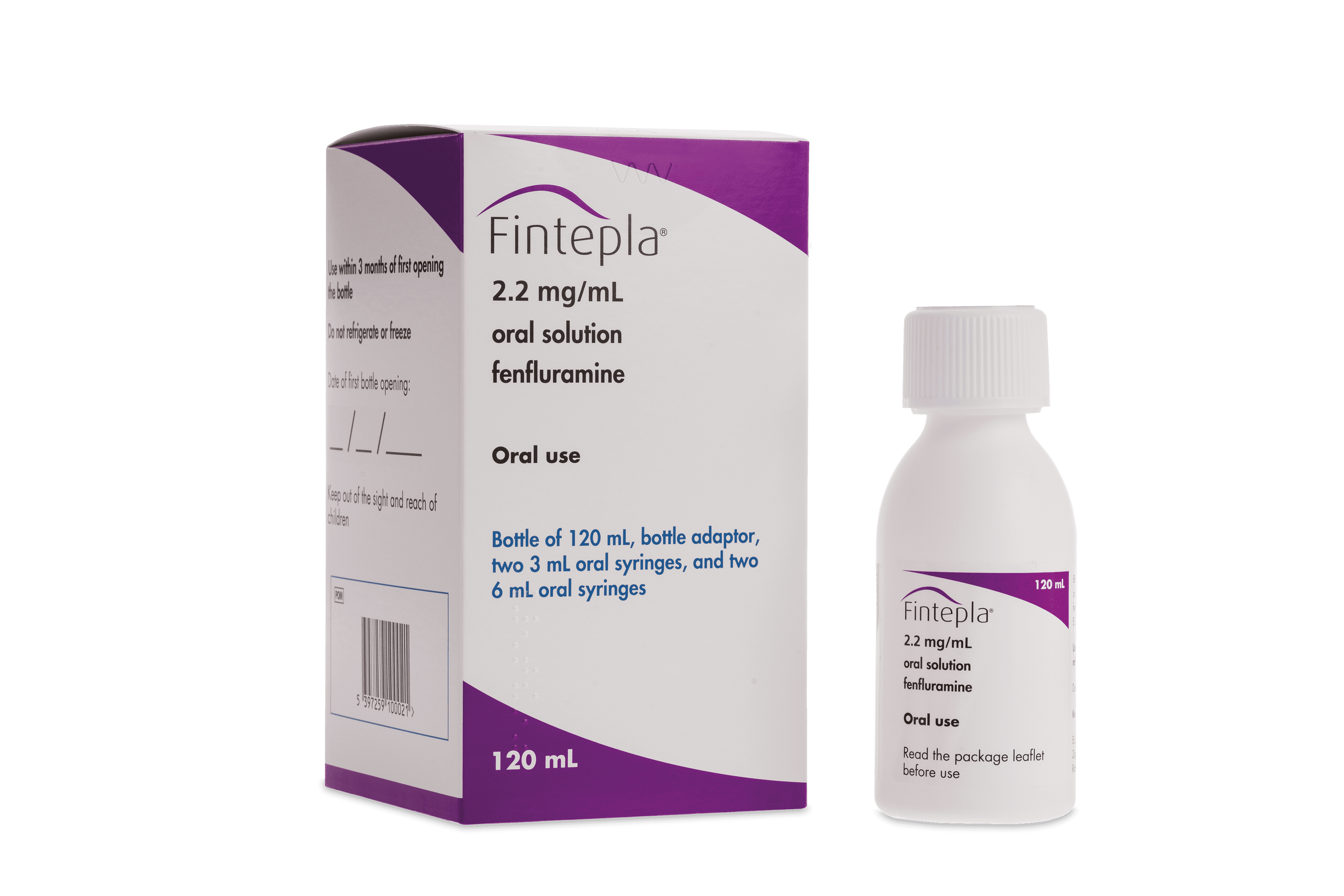
 

Fintepla oral solution bottle and carton packaging.

Please see SmPC for further information.

Teal icon of two tablets

Fintepla offers convenient oral dosing

Fintepla® oral solution is supplied as a clear, colourless, cherry-flavoured, slightly viscous liquid, that can be administered with or without food. Fintepla® is supplied with 2 calibrated oral dosing syringes (3ml or 6ml) for accurate and flexible dosing.1

Teal icon of waveform symbol

Echocardiogram monitoring

Prior to starting treatment, patients must undergo an echocardiogram to establish a baseline prior to initiating treatment and exclude any pre-existing valvular heart disease or pulmonary hypertension.

It should be performed at baseline, every 6 months for the first 2 years, and annually thereafter.

After discontinuation of treatment, an echocardiogram should be performed 3-6 months after the last dose.

Teal icon showing person silhouette and unlocked padlock

The Fintepla® Controlled Access Programme (CAP)

Prior to starting treatment, patients must undergo an echocardiogram to establish a baseline prior to initiating treatment and exclude any pre-existing valvular heart disease or pulmonary hypertension.

It should be performed at baseline, every 6 months for the first 2 years, and annually thereafter.

After discontinuation of treatment, an echocardiogram should be performed 3-6 months after the last dose.

Fintepla® should be initiated and supervised by healthcare professionals with experience in the treatment of epilepsy

Fintepla® should be prescribed and dispensed according to the Fintepla® Controlled Access Programme.1

Steps to initiation for your patient 2 years old and older with Dravet syndrome or Lennox-Gastaut syndrome


Four numbered circular panels labelled 01 to 04 arranged in a grid.

Step 1

Obtain your unique Controlled Access Programme Identification number through the Fintepla® CAP portal. You only need to do this once as your unique ID will be used for all your Fintepla® prescriptions.

Four numbered circular panels labelled 01 to 04 arranged in a grid.

Step 2

Arrange an echocardiogram to establish a baseline prior to initiating treatment and exclude any pre-existing valvular heart disease or pulmonary arterial hypertension (PAH).

Four numbered circular panels labelled 01 to 04 arranged in a grid.

Step 3

Calculate Fintepla® starting dose and titration schedule.

Four numbered circular panels labelled 01 to 04 arranged in a grid.

Step 4

Plan follow-ups and treatment evaluation.

Fintepla® should be prescribed and dispensed according to the Fintepla® Controlled Access Programme.1

Have you heard our podcast?

Listen to Mike Taylor and guest speakers on Let's Talk about Dravet Syndrome discussing: The facts about DS, Neurodevelopmental impact of Dravet syndrome and lots more!

Circular microphone icon.

Do you know your local UCB specialist?


Speech bubble outline graphic

Fintepla®▼ (fenfluramine) is indicated for the treatment of seizures associated with Dravet syndrome and Lennox-Gastaut syndrome as an add-on therapy to other antiepileptic medicines for patients 2 years of age and older.1

Rystiggo®▼ (rozanolixizumab) is indicated as an add-on to standard therapy for the treatment of generalised myasthenia gravis (gMG) in adult patients who are anti-acetylcholine receptor (AChR) or anti-muscle-specific tyrosine kinase (MuSK) antibody positive.

Rystiggo currently not reimbursed on the NHS in Scotland.

Zilbrysq®▼ (zilucoplan) is indicated as an add-on to standard therapy for the treatment of generalised myasthenia gravis (gMG) in adult patients who are anti-acetylcholine receptor (AChR) antibody positive.


Abbreviations:

DS, Dravet syndrome; LGS, Lennox-Gastaut syndrome.

References:

1. Fintepla® Summary of Product Characteristics.

2. Lagae L, Sullivan J, Knupp K, et al. FAiRE DS Study Group. Lancet. 2019;394(10216):2243–54.

3. Nabbout R, Mistry A, Zuberi S, et al. JAMA Neurol. 2020;77(3):300–8.

4. Knupp KG, Scheffer IE, Ceulemans B, et al. Epilepsia. 2023;64(1): 139–51.

GB-FA-2500159 | September 2026