
Learn more about Fintepla dosing
Learn more about Fintepla dosing


Strategies & expert guidance from leading epileptologists for personalised seizure management1
Five expert epileptologists from France, Spain, Italy, and the UK have published updated recommendations for the diagnosis and management of LGS, focusing on evidence from clinical trials, real-world practice, and expert opinion.
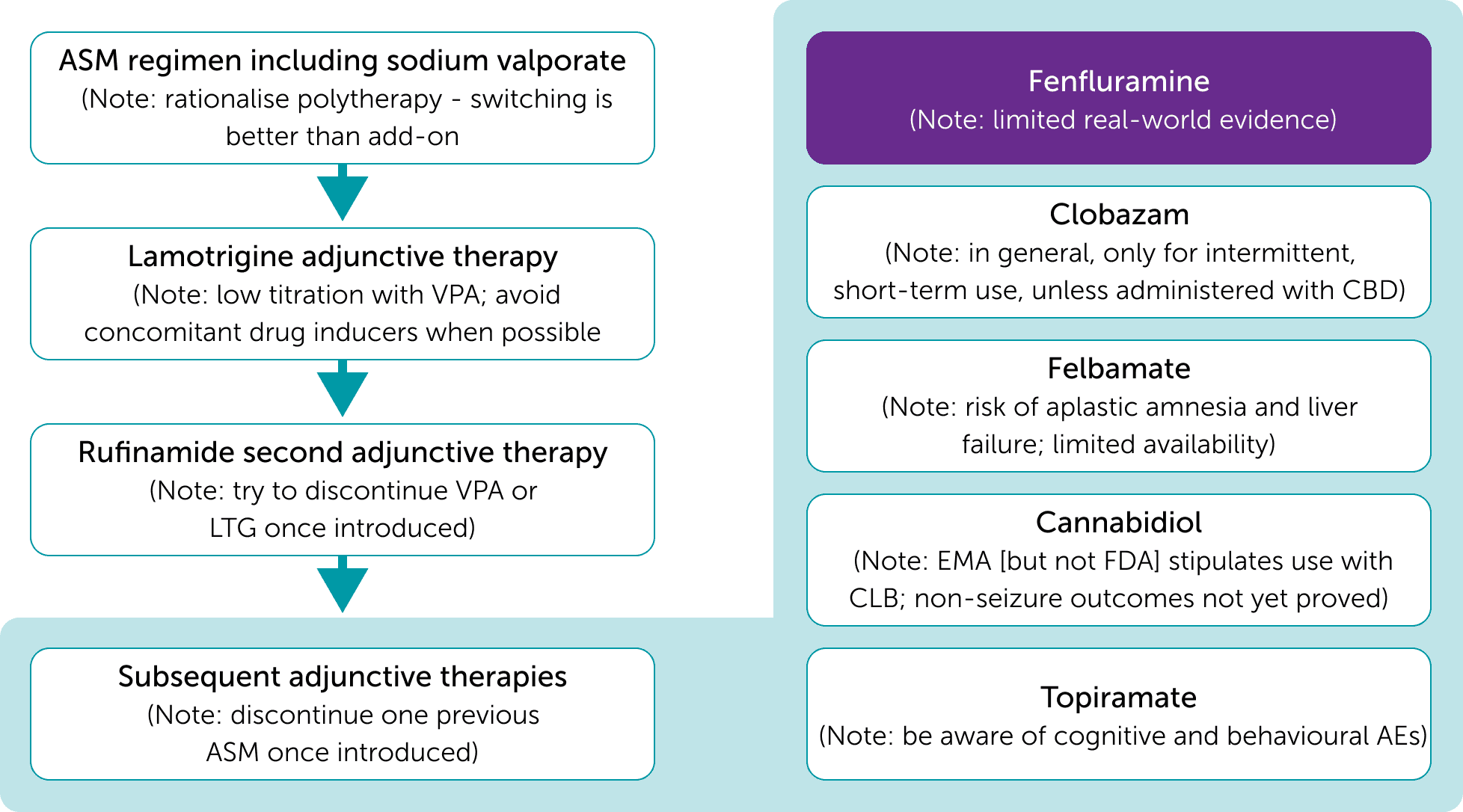
Updated pharmacological treatment algorithm for a newly diagnosed patient with LGS or patients with LGS already receiving ASM therapy1
Adapted from: Auvin S. Epilepsia Open. 2025;10(1):85–106.
Felbamate [unlicensed] may be considered as adjunctive therapy under the supervision of a neurologist with expertise in epilepsy when all other treatment options are unsuccessful.
Please refer to the SmPC for each respective drug for the most up-to-date information on their individual dosing.
LGS Characteristics & Diagnosis1
Onset: Typically in childhood (3–5 years).
Clinical Features: Multiple seizure types (characterized by multiple types of drug-resistant seizures), evolving EEG changes, impaired cognition and behavior, and poor quality of life due to refractory seizures.
Diagnosis Challenges: Evolving seizure types and EEG patterns complicate diagnosis; early diagnosis is critical for optimal outcomes.
Prognosis: Drug-resistant seizures often persist into adulthood; low likelihood of seizure freedom; increased risk of status epilepticus and SUDEP.
Management Principles1
Individualised Approach: Management must balance seizure control, treatment burden, side effects, and evolving patient needs.
ASMs: Emphasis on antiseizure medications (ASMs) with novel mechanisms, especially highly purified cannabidiol (CBD) and fenfluramine.
Algorithm: A tailored approach is essential for managing the multiple seizure types and comorbidities commonly associated with LGS, ultimately aiming to optimize therapeutic outcomes in this challenging patient population.
Recommendations1
Regular Review: At least annually by a neurologist experienced in complex epilepsies and drug interactions.
Reassessment: Ongoing review of diagnosis and treatment plan using EEG (including sleep EEG), MRI, and genetic testing.
Awareness: Recognise that classic EEG features may evolve or disappear; reassess clinical and EEG findings as needed.
Genetic Counselling: Offer if appropriate.
NICE & HSE recommendation of the use of Fintepla
Fintepla® (fenfluramine) is indicated for the treatment of seizures associated with Dravet syndrome and Lennox-Gastaut syndrome as an add-on therapy to other antiepileptic medicines for patients 2 years of age and older.2
The most commonly(≥1/10) reported adverse events are: Decreased appetite; Fatigue; Diarrhoea; Somnolence. Please refer to the Summary of Product Characteristics for further details of adverse events. Fintepla® should be initiated and supervised by healthcare professionals with experience in the treatment of epilepsy. Fintepla® is prescribed and dispensed according to the Fintepla® Controlled Access Programme (CAP).
The CAP has been created to: 1. Prevent off-label use in weight management in obese patients 2. Confirm that prescribing physicians have been informed of the need for periodic cardiac monitoring in patients taking Fintepla®
Please refer to the SmPC for further information.


Fintepla®▼ (fenfluramine) is indicated for the treatment of seizures associated with Dravet syndrome and Lennox-Gastaut syndrome as an add-on therapy to other antiepileptic medicines for patients 2 years of age and older.1
Rystiggo®▼ (rozanolixizumab) is indicated as an add-on to standard therapy for the treatment of generalised myasthenia gravis (gMG) in adult patients who are anti-acetylcholine receptor (AChR) or anti-muscle-specific tyrosine kinase (MuSK) antibody positive.
Rystiggo currently not reimbursed on the NHS in Scotland.
Zilbrysq®▼ (zilucoplan) is indicated as an add-on to standard therapy for the treatment of generalised myasthenia gravis (gMG) in adult patients who are anti-acetylcholine receptor (AChR) antibody positive.
Abbreviations:
DS, Dravet syndrome; LGS, Lennox-Gastaut syndrome.
References:
1. Auvin S, Arzimanoglou A, Falip M, et al. Refining management strategies for Lennox-Gastaut syndrome: Updated algorithms and practical approaches. Epilepsia Open. 2025;10(1):85-106.
2. Fintepla® Summary of Product Characteristics.
GB-FA-2600053 | September 2026