
Fintepla® is indicated for the treatment of seizures associated with Dravet syndrome and Lennox-Gastaut syndrome as an add-on therapy to other antiepileptic medicines for patients 2 years of age and older.

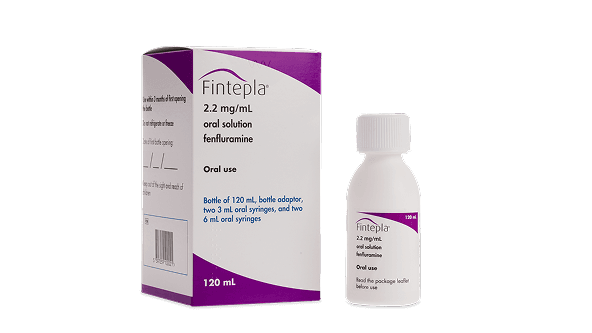
Product is only stock image and not true to size.
Adapted from Fintepla® Summary of Product Characteristics.


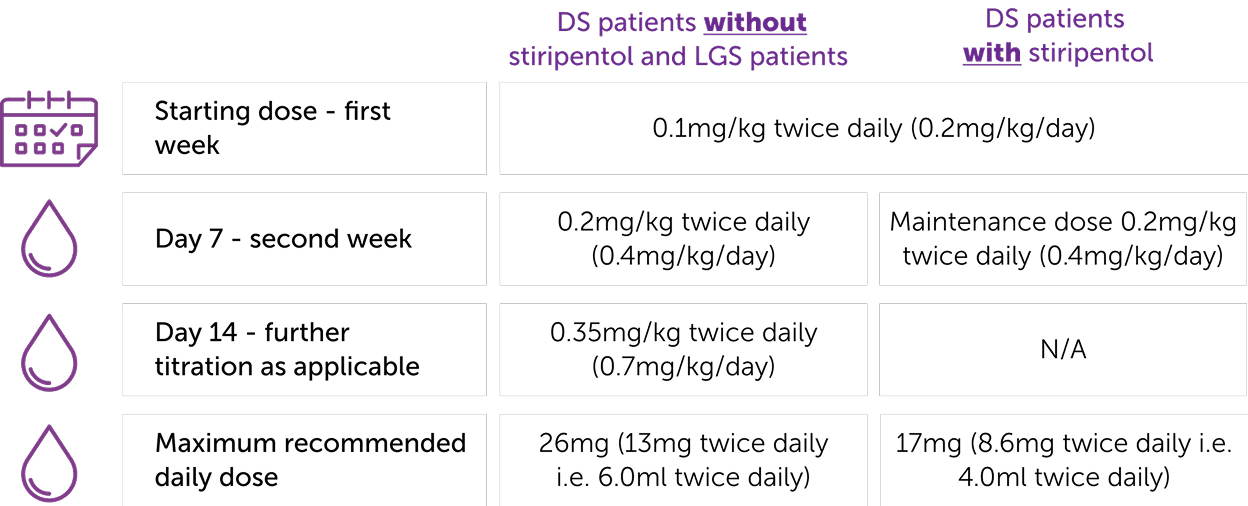
For patients who are tolerating Fintepla® and require a further reduction of seizures. For patients not on concomitant stiripentol requiring more rapid titration, the dose may be increased every 4 days. Each ml of Fintepla® oral solution contains 2.2mg of fenfluramine hydrochloride. Always round the calculated dose up or down to the nearest graduation mark, following standard rounding conventions.
For patients with Dravet syndrome, dosage may be increased based on clinical response to the maximum recommended dosage, as needed.
For patients with Lennox-Gastaut syndrome, dosage should be increased as tolerated to the recommended maintenance dosage (i.e., Day 14)
Dosage adjustments of other ASMs
No dose adjustment of ASMs such as valproate, clobazam, stiripentol or cannabidiol was necessary when fenfluramine was co-administered in the treatment of Dravet syndrome or Lennox-Gastaut syndrome.
A maximum fenfluramine dose of 17mg/day is recommended if used with stiripentol.1
Discontinuing Fintepla in Dravet syndrome and Lennox-Gastaut syndrome
When discontinuing Fintepla, the dose should be decreased gradually. Abrupt discontinuation should be avoided when possible to minimise the risk of increased seizure frequency and status epilepticus.1
After discontinuation of treatment, an echocardiogram should be performed 3-6 months after the last dose.1
Special populations and contraindications
Fintepla® is not recommended for use in patients with moderate and severe hepatic impairment treated with stiripentol.1
A slower titration may be considered in patients with hepatic impairment. If adverse reactions are reported, a dose reduction may be needed. Fintepla® has not been studied in patients with end-stage renal disease.
Generally, no dose adjustment is recommended when Fintepla® is administered to patients with mild to severe renal impairment, however, a slower titration may be considered. If adverse reactions are reported, a dose reduction may be needed.
There are no specific clinical data on the use of Fintepla® with stiripentol in patients with impaired renal function. Fintepla® is therefore not recommended for use in patients with impaired renal function treated with stiripentol.1 Please see SmPC for further information.
Fintepla® is contraindicated in patients with hypersensitivity to the active substance or any of the excipients listed in section 6.1 of the SmPC, patients with aortic or mitral valvular heart disease, and pulmonary arterial hypertension, and within 14 days of the administration of monoamine oxidase inhibitors due to an increased risk of serotonin syndrome.1
In patients with severe hepatic impairment (Child-Pugh C) not receiving concomitant stiripentol, the maximum dose for these patients is 0.2mg/kg twice daily and the maximal total daily dose is 17mg.1
Safety profile of Fintepla®
The most commonly (≥1/10) reported adverse events are: Decreased appetite; Fatigue; Diarrhoea; Somnolence. Please refer to the Summary of Product Characteristics for further details of adverse events.1
Fintepla® should be initiated and supervised by healthcare professionals with experience in the treatment of epilepsy. Fintepla® is prescribed and dispensed according to the Fintepla® Controlled Access Programme (CAP).1
Have you heard our podcast?
Listen to Mike Taylor and guest speakers on Let's Talk about Dravet Syndrome discussing: The facts about DS, Neurodevelopmental impact of Dravet syndrome and lots more!


Fintepla®▼ (fenfluramine) is indicated for the treatment of seizures associated with Dravet syndrome and Lennox-Gastaut syndrome as an add-on therapy to other antiepileptic medicines for patients 2 years of age and older.1
Rystiggo®▼ (rozanolixizumab) is indicated as an add-on to standard therapy for the treatment of generalised myasthenia gravis (gMG) in adult patients who are anti-acetylcholine receptor (AChR) or anti-muscle-specific tyrosine kinase (MuSK) antibody positive.
Rystiggo currently not reimbursed on the NHS in Scotland.
Zilbrysq®▼ (zilucoplan) is indicated as an add-on to standard therapy for the treatment of generalised myasthenia gravis (gMG) in adult patients who are anti-acetylcholine receptor (AChR) antibody positive.
Abbreviations:
DS, Dravet syndrome; LGS, Lennox-Gastaut syndrome; ASM, Antiseizure medication.
References:
1. Fintepla® Summary of Product Characteristics
GB-FA-2500162 | September 2026